What To Budget For a Smart Home in Singapore: HDB, Condo & Landed
Short answer: A smart home in Singapore in 2026 typically costs $4,000-$22,000+ for HDB, $4,500-$35,000+ for condos, and $6,000-$80,000+ for landed properties, depending on how much you automate.
The biggest factor isn't the devices themselves, it's whether you DIY (cheaper upfront, messier long-term) or go with professional integration (higher upfront, but one app, one system, actual support). If you're renovating, do it now: you'll save 20-30% vs retrofitting later.
Introduction
Planning a smart home in Singapore, but unsure what you'll actually spend? You're not alone. Most homeowners start Googling individual device prices, only to realise the real cost has very little to do with any single gadget.
Your smart home budget depends on three things: your property type, how deep you want to go, and whether you're buying products or paying for a properly integrated system. This guide breaks it all down, so you can plan with real numbers, not guesswork.
What You're Actually Paying For: Professional Integration vs DIY
Before we talk numbers, let's clear up the biggest misconception: a smart home isn't just a collection of smart devices. Two homeowners can spend the same amount and end up with completely different experiences, because what you're paying for matters more than how much.
The DIY Route
You pick up smart bulbs, a Wi-Fi plug, maybe a robot vacuum, and connect everything through a mix of apps. It works, sort of. You'll have one app for your lights, another for your camera, another for your air-con control. When something disconnects at 2am, you're the IT department.
DIY is fine for experimenting with one or two devices. But once you go beyond a single room, you start running into protocol conflicts (Zigbee vs Wi-Fi vs Bluetooth), unreliable automations, and a phone full of apps that don't talk to each other.
Typical DIY spend: $300-$1,500 for a basic setup, but factor in replacements, workarounds, and your own time.
Professional Integration
Here, you're not just buying devices. You're paying for someone to design a system around your home's layout, wire it properly, unify everything under one control platform, program your automations, and support you after installation.
The devices are a portion of the cost. The real value is in the engineering: making sure your lights, security, air-con, and sensors all work as one system, not a patchwork of apps.
Take Home-A-Genius as an example. Our packages start from $4,150 (including GST) for a fully installed 3-room HDB system. That single price covers the hardware, system design, installation, automation programming, a handover training session, and lifetime remote support. No subscriptions, no hidden add-ons. That's what "professional integration" actually means: the price you see is the price you pay.
What professional integration typically includes:
- On-site consultation and system design
- Electrical and wiring preparation
- Device supply, installation, and configuration
- Automation programming (scenes, schedules, sensor triggers)
- Single-app control with no reliance on Google Home or Alexa as a crutch
- Post-installation support and troubleshooting
Quick Comparison
| DIY | Professional Integration | |
|---|---|---|
| Upfront cost | Lower | Higher |
| Number of apps | 3-6 | 1 |
| Reliability | Inconsistent | Stable (local processing) |
| Scalability | Limited by protocol mismatches | Built to expand |
| Support | Forums and YouTube | Dedicated team |
| 3-year total cost of ownership | Often comparable once replacements and add-ons stack up | Predictable, with warranty coverage |
The bottom line: DIY is cheaper on day one. Professional integration is cheaper over the life of your home.
Smart Home Budget by Property Type
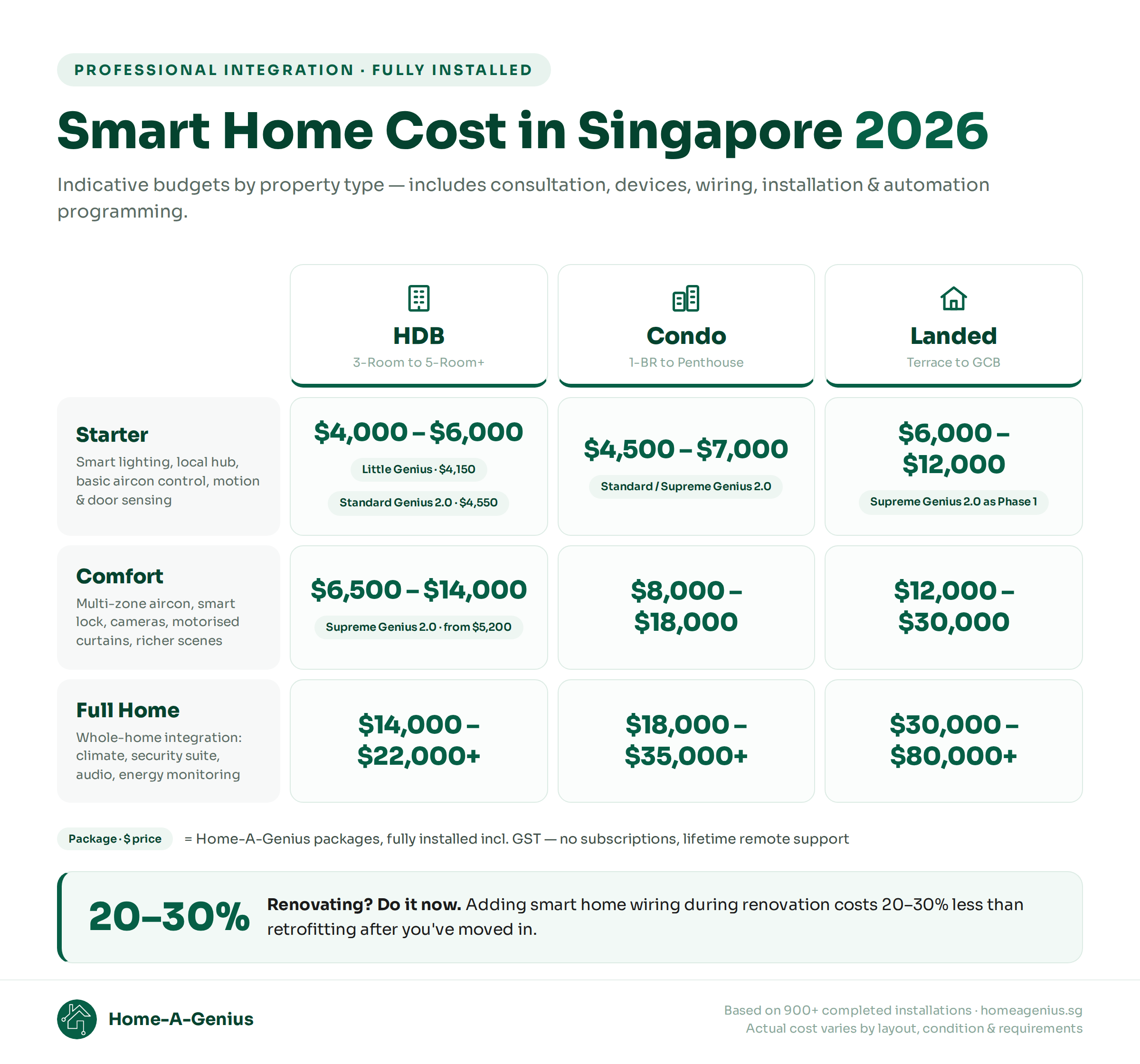
Below are indicative budget ranges for 2026, based on professional integration. These include consultation, devices, wiring, installation, and programming. Actual costs vary depending on your home's condition, layout complexity, and specific requirements.
HDB Flats (3-Room to 5-Room+)
HDB flats are the most common starting point for smart home adoption in Singapore, and the good news is they're also the most straightforward to work with due to their compact layouts. In fact, the majority of Home-A-Genius's 900+ completed installations are HDB homes.
Starter Tier, $4,000 to $6,000
Covers the essentials: smart lighting control throughout the unit (up to 7-12 lighting points), a local hub running on Zigbee 3.0, basic aircon control, motion and door sensing, and single-app management. This is the "I want to come home to lights that turn on automatically and switch everything off with one tap at bedtime" setup.
For reference, Home-A-Genius's Little Genius package starts at $4,150 for a 3-room HDB (up to 7 lighting points, one-zone aircon, motion and door sensing), while their Standard Genius 2.0 package at $4,550 covers a 4-room flat with up to 12 lighting points and two-zone aircon control.
Comfort Tier, $6,500 to $14,000
Adds multi-zone aircon control (with deep integration for brands like Daikin iSmile and Mitsubishi Electric, not just basic IR blasting), additional motion sensors, a smart door lock, a video doorbell or corridor camera (where HDB guidelines allow), motorised curtains, and fan control. Automations get smarter here: lights that respond to occupancy, aircon that adjusts based on time and presence, and evening scenes that set the whole flat with one tap.
Home-A-Genius's Supreme Genius 2.0 package ($5,200) sits at the entry point of this tier, covering up to 18 lighting points with curtain and fan control for a 5-room flat. Add-ons like smart locks, additional cameras, and deeper aircon integration push you further into this range.
Full Home Tier, $14,000 to $22,000+
The whole unit is integrated. Comprehensive climate control across every room, motorised curtains or blinds, a home security suite (cameras, leak sensors, smoke detectors), smart audio in multiple rooms, whole-home Wi-Fi networking, energy monitoring, and advanced automations that tie everything together.
At this level, you'll get a smart home floor plan interface (a live top-down view of your actual layout showing which rooms are on) where you can see and control every device at a glance.
HDB-specific things to note:
- BTO vs resale: BTO owners renovating from scratch can run wiring cleanly behind walls, which reduces cost and looks better. Resale units may need additional wiring work, adding $1,000-$3,000 depending on the existing electrical setup. A good integrator will coordinate directly with your ID and electrician before ceilings close to get this right.
- Neutral wire or not: Many older HDB flats lack neutral wires at switch points. Home-A-Genius handles this with wireless switches that bind to the circuit, so no hacking is required.
- Corridor restrictions: HDB has guidelines on what you can install along common corridors. Not every door camera or sensor mounting is permitted, so check before you plan.
- Wi-Fi coverage: Most 4- and 5-room flats can get away with a single access point for smart home traffic, but thicker walls in older blocks may need a second. Home-A-Genius models coverage from your floor plan before installation, not after.
Condos (1-Bedroom to Penthouse)
Condos tend to come with more existing infrastructure (built-in intercoms, wired access controls, sometimes pre-wired Cat6 or smart provisions in newer developments), but also more restrictions.
Starter Tier, $4,500 to $7,000
Smart lighting, a local hub, basic climate control, and motion/door sensing. Newer condos may already have some wiring in place, which can reduce installation costs slightly. Home-A-Genius's Standard Genius 2.0 ($4,550) and Supreme Genius 2.0 ($5,200) packages both work well as condo starting points depending on unit size.
Comfort Tier, $8,000 to $18,000
Adds comprehensive climate control across multiple aircon units (with two-way feedback for supported brands, so the app shows the unit's true state, not just the last command sent), motorised blinds (popular for floor-to-ceiling condo windows via Somfy or A-OK integration), a security layer with HikVision cameras and sensors, a smart lock, and integrated intercom where possible. Scene control for entertaining (movie mode, dinner mode) starts to make sense in condo living rooms.
Full Home Tier, $18,000 to $35,000+
Full integration including multi-room audio, automated lighting scenes by time of day, tunable white lighting that shifts from warm amber in the evening to daylight-clear in the morning, bathroom occupancy automations, energy monitoring, leak detection, and a centralised control panel or smart display. Penthouses and larger units push toward the higher end due to the sheer number of zones and devices.
Condo-specific things to note:
- MCST rules: Your management committee may restrict external installations (cameras facing corridors, sensors on facades). Always check before committing to an exterior security plan.
- Existing smart provisions: Some newer condos come "smart-home ready" with pre-run wiring or built-in device slots. This can save on wiring costs, but the provisions don't always match the system you want, so don't assume compatibility.
- Intercom integration: Older condo intercom systems often use proprietary protocols. Integrating them into a unified smart home system may or may not be feasible depending on the brand and model.
Landed Properties
Landed homes are where smart home integration truly shines, but also where complexity (and cost) scales up. Multiple storeys, outdoor spaces, gates, and larger floor areas mean more devices, more wiring, and more planning.
Starter Tier, $6,000 to $12,000
Smart lighting for key living areas, a hub, climate control for main zones, a smart gate lock or digital lock, and basic security cameras. Even at the starter level, landed homes need more infrastructure than flats simply due to size. Home-A-Genius's Supreme Genius 2.0 package can serve as a first phase for landed homes, with further zones added over time.
Comfort Tier, $12,000 to $30,000
Whole-home lighting automation across all storeys, comprehensive security (perimeter cameras, gate sensors, motion detectors for the garden and driveway), multi-zone climate management, motorised curtains, and a video intercom at the gate with app-based gate control. Automations start connecting indoor and outdoor systems: porch lights that trigger on arrival, security that arms when everyone leaves.
Full Home Tier, $30,000 to $80,000+
This is the full experience. Automated gate and driveway systems, outdoor garden and landscape lighting control, a whole-home audio system, motorised skylights or louvres, pool equipment integration where applicable, comprehensive energy monitoring, and advanced security with zone-based alerts. Every room, every floor, every outdoor area is part of one unified system. Home-A-Genius quotes landed full-integration projects after a site visit, since no two landed homes have the same layout or requirements.
Landed-specific things to note:
- Wiring is critical: Landed homes almost always need significant wiring work, especially older properties. Budget an additional $3,000-$8,000 for electrical preparation if your home hasn't been recently renovated.
- Network backbone: A single router won't cut it. Landed homes need a proper wired network backbone (Ethernet backhaul via Omada or similar) with access points per floor to keep smart devices reliably connected. Factor $800-$2,000 for network infrastructure. Home-A-Genius includes network planning and heatmap modelling as part of their landed projects.
- Professional integration is almost non-negotiable: The sheer number of systems (gate, lighting, HVAC, security, audio, outdoor) in a landed property makes DIY impractical. Protocol management alone across 50+ devices requires a unified platform.
The Hidden Costs Most Guides Don't Mention
Every smart home budget should account for these often-overlooked line items. One advantage of working with an all-in integrator like Home-A-Genius is that most of these are bundled into your quote upfront, so there are no surprises after you've signed.
Wiring and electrical prep: If your home's electrical layout doesn't support neutral wires at switch points (common in older HDB and landed units), rewiring is necessary. This is often the single biggest "surprise" cost, ranging from $1,000 to $5,000+. A good integrator will flag this during consultation, not after installation day.
Network infrastructure: Smart devices need a reliable network. If your current Wi-Fi can barely handle Netflix, it won't handle 30+ connected devices. A proper mesh setup or wired backbone costs $300-$2,000 depending on your property size.
Subscription fees: Some cloud-based systems charge monthly for features like remote access, video storage, or advanced automations. Over 3-5 years, these subscriptions add up to thousands. Systems that run on a local hub (like Home-A-Genius's) process everything on-site, so there are zero ongoing fees. Your automations, scenes, and schedules keep running even if the internet drops.
Maintenance and replacement cycles: Batteries in sensors and locks need replacing. Devices eventually fail or become unsupported. Budget roughly 5-10% of your setup cost annually for upkeep. Look for integrators that offer warranty coverage on parts and labour (Home-A-Genius includes up to two years).
The switching cost: If you go cheap now with a closed ecosystem and want to upgrade later, you may need to replace everything. Roughly one in three of Home-A-Genius's installations is a rescue job on someone else's system. Investing in an open, scalable platform upfront avoids this trap entirely.
When to Invest: During Renovation or After?
During renovation (BTO or major reno): This is the sweet spot. Your contractor is already opening walls, running wires, and coordinating trades. Adding smart home wiring at this stage costs 20-30% less than retrofitting later, and the result looks cleaner with no exposed cables or surface-mounted devices. Home-A-Genius coordinates directly with your ID and electrician, so you're not the one relaying messages between trades.
After you've moved in: Still very doable, especially with wireless Zigbee devices that don't require new wiring for every switch. You'll pay a bit more for installation (some areas may need minor hacking to run cables), but a good integrator can work around existing setups without tearing your home apart.
The phased approach: If your budget is tight, start with lighting and a hub during renovation (get the wiring done right), then layer on security, climate, and audio in the months after. Home-A-Genius's system is modular by design, so adding devices later is as simple as pairing them to your existing hub and updating your automations.
How to Right-Size Your Budget
Not sure where to start? Here's a simple framework:
Prioritise by daily impact. Lighting and climate control affect your comfort every single day. Start there. Door locks and security cameras are next for peace of mind. Multi-room audio and motorised blinds are lifestyle upgrades to add once the foundation is solid.
Plan for scalability. Choose a platform that supports multiple protocols and can grow with you. Adding two sensors next year shouldn't require a new hub or a new app.
Budget for the system, not just the devices. A $50 smart switch and a $100 smart switch might look the same on paper. The difference is what's behind it: the platform, the support, the integration. That's where the value lives.
Get a consultation before you commit. A 45-minute walkthrough of your floor plan with a professional will give you a realistic budget range and help you avoid overspending on features you won't use.
Founder's Take: What We Tell Every Homeowner Before They Spend a Dollar
Cheryl Chiang, co-founder & COO of Home-A-Genius, has overseen 900+ smart home installations across Singapore since 2017.
"The common misconception is that bespoke means expensive and out of reach."
"Most people walk into our showroom assuming a locally controlled, professionally integrated smart home is only for landed properties or luxury condos. That's really not true anymore. Our starter package begins at $4,150 for a 3-room HDB, fully installed. Local-first systems are built to scale and can be surprisingly accessible.
Where homeowners really overspend is on the wrong approach. Someone buys $800 worth of Wi-Fi switches, sets them up across four apps, and six months later they're in our showroom asking us to redo everything. That $800 is gone. A starter-tier professional setup would have cost less in total and worked from day one.
One more thing: your renovation window is your best friend. Running smart home cables while the walls are open adds very little to the job. Once ceilings are closed, the same work costs two to three times more. Even if your budget only covers lighting and a hub now, get the wiring done during renovation. You can add the rest later, but you can't easily add cables after the fact."
See It Running Before You Commit
Reading about smart home costs is useful. Experiencing a working system is better. At the Home-A-Genius Experience Centre in Tampines North, everything in this guide is running live. Walk through a fully integrated setup, press the switches, drop the internet, and watch what keeps working.
Around 45 minutes, by appointment. You'll leave knowing exactly what to budget, what to prioritise, and what to skip. If you're mid-renovation, the team can join a call with your ID the same week. Book a free consultation today!